
Penetration Testing

GettyImages-2172166252-1-1-e1770046128493

Understand Your Risk With a Web Application Penetration Test

A web application penetration test is the best way to identify weaknesses within your application. At Triaxiom we test for all of the OWASP Top-10 critical security flaws, as well as other potential vulnerabilities.

Charlotte, N.C.-Based Pen Test Partner For 650+ Organizations

At Triaxiom Security, we specialize in web app penetration testing. Our engineers have industry-recognized certifications and a wealth of experience performing penetration tests for Fortune 500 companies, small start-ups, Government agencies, Higher Education, Regional and Metro Hospitals, Payment Processors, Top US Financial Institutions,  and everything in between.

Penetration Tests We Offer

Web Application Penetration Test

A web application penetration test is an in-depth penetration test on both the unauthenticated and authenticated portions of your website. The engineer will test for all of the OWASP Top-10 critical security flaws, as well as a variety of other potential vulnerabilities based on security best practice. Activities include:

  • Website mapping techniques such as spidering
  • Directory enumeration
  • Automated and manual tests for injection flaws on all input fields
  • Directory traversal testing
  • Malicious file upload and remote code execution
  • Password attacks and testing for vulnerabilities in the authentication mechanisms
  • Session attacks, including hijacking, fixation, and spoofing attempts
  • Other tests depending on specific site content and languages
External Penetration Test

An external penetration test emulates an attacker trying to break into your network from the outside. The goal of the engineer performing this assessment is to breach the perimeter and prove they have internal network access. This test includes:

  • Open source reconnaissance against the organization
  • Full port scan covering all TCP ports and the top 1,000 UDP ports of the targets in scope
  • Full vulnerability scan of the targets
  • Manual and automated exploit attempts
  • Password attacks
Internal Penetration Test

An internal penetration test emulates an attacker on the inside of your network. This could be either an attacker who is successful in breaching the perimeter through another method or a malicious insider. The goal of the engineer in this module is to gain root and/or domain administrator level access on the network, and gain access to sensitive files. Activities include:

  • Active and Passive network reconnaissance including traffic sniffing, port scanning, LDAP enumeration, SMB enumeration, etc.
  • Vulnerability scan on all in-scope targets
  • Spoofing attacks such as ARP cache poisoning, LLMNR/NBNS spoofing, etc.
  • Manual and automated exploit attempts
  • Shared resource enumeration
  • Password attacks
  • Pivoting attacks
Wireless Penetration Test

A wireless penetration test is a comprehensive evaluation of the wireless networks in your organization using automated and manual methods. Areas covered include:

  • Password attacks
  • WEP/WPA cracking
  • Guest wireless segmentation checks
  • Traffic sniffing attacks
  • SSID spoofing
  • Rogue access point discovery
Social Engineering Assessment

This assessment is designed to target and take advantage of the human-element to gain access to your network. This is done using a variety of methods to get an employee to click on something they shouldn’t, enter their credentials or otherwise provide them when they shouldn’t, or divulge information that may assist an attacker in breaching your network. The goal for the engineer performing this assessment is to gain information that may assist an attacker in future attacks, gather credentials, or gain a foothold on the internal network. This assessment will include:

  • Phone-based attacks
  • Spear phishing attacks
  • Bulk phishing attacks
Physical Penetration Test

A physical penetration test is an assessment of the physical security of your premises. Our engineers will attempt to gain access to your facility by identifying weaknesses and/or using social engineering. Once inside, our engineers will attempt to gather sensitive information, gain access to sensitive areas such as the data center, and attempt to gain internal network access.

Vulnerability Scanning

Vulnerability scanning is a regular, automated process that identifies the potential points of compromise on a network. A vulnerability scan detects and classifies system weaknesses in computers, networks and communications equipment and predicts the effectiveness of countermeasures. Our engineers will conduct this scan for you and use our expertise to remove false positives and produce a risk-prioritized report.

API Penetration Test

An API penetration test emulates an attacker trying to exploit vulnerabilities within your API that may allow him to bypass authentication controls, access sensitive data, or otherwise disrupt the service. The goal of the engineer performing this assessment is to comprehensively review your API for OWASP Top 10 vulnerabilities and exploit any vulnerability that may allow the engineer to bypass security controls. Our API Penetration Testing includes:

  • Method and parameter fuzzing
  • Injection attacks, such as SQLi, XSS, XPath, Command
  • Authentication bypass and privilege escalation attempts
  • Authorization testing to assess the security of data in multi-tenant configurations including:
    • Direct object references
    • Client or user impersonation
    • Authorization bypass
    • Information Leakage between clients
  • Analyzing headers and error messages for information disclosure
  • Identification of unnecessary information returned or data leakage
  • Analysis of server-level transport encryption for security best practice

A web application penetration test is an in-depth penetration test on both the unauthenticated and authenticated portions of your website. The engineer will test for all of the OWASP Top-10 critical security flaws, as well as a variety of other potential vulnerabilities based on security best practice. Activities include:

  • Website mapping techniques such as spidering
  • Directory enumeration
  • Automated and manual tests for injection flaws on all input fields
  • Directory traversal testing
  • Malicious file upload and remote code execution
  • Password attacks and testing for vulnerabilities in the authentication mechanisms
  • Session attacks, including hijacking, fixation, and spoofing attempts
  • Other tests depending on specific site content and languages

An external penetration test emulates an attacker trying to break into your network from the outside. The goal of the engineer performing this assessment is to breach the perimeter and prove they have internal network access. This test includes:

  • Open source reconnaissance against the organization
  • Full port scan covering all TCP ports and the top 1,000 UDP ports of the targets in scope
  • Full vulnerability scan of the targets
  • Manual and automated exploit attempts
  • Password attacks

An internal penetration test emulates an attacker on the inside of your network. This could be either an attacker who is successful in breaching the perimeter through another method or a malicious insider. The goal of the engineer in this module is to gain root and/or domain administrator level access on the network, and gain access to sensitive files. Activities include:

  • Active and Passive network reconnaissance including traffic sniffing, port scanning, LDAP enumeration, SMB enumeration, etc.
  • Vulnerability scan on all in-scope targets
  • Spoofing attacks such as ARP cache poisoning, LLMNR/NBNS spoofing, etc.
  • Manual and automated exploit attempts
  • Shared resource enumeration
  • Password attacks
  • Pivoting attacks

A wireless penetration test is a comprehensive evaluation of the wireless networks in your organization using automated and manual methods. Areas covered include:

  • Password attacks
  • WEP/WPA cracking
  • Guest wireless segmentation checks
  • Traffic sniffing attacks
  • SSID spoofing
  • Rogue access point discovery

This assessment is designed to target and take advantage of the human-element to gain access to your network. This is done using a variety of methods to get an employee to click on something they shouldn’t, enter their credentials or otherwise provide them when they shouldn’t, or divulge information that may assist an attacker in breaching your network. The goal for the engineer performing this assessment is to gain information that may assist an attacker in future attacks, gather credentials, or gain a foothold on the internal network. This assessment will include:

  • Phone-based attacks
  • Spear phishing attacks
  • Bulk phishing attacks

A physical penetration test is an assessment of the physical security of your premises. Our engineers will attempt to gain access to your facility by identifying weaknesses and/or using social engineering. Once inside, our engineers will attempt to gather sensitive information, gain access to sensitive areas such as the data center, and attempt to gain internal network access.

Vulnerability scanning is a regular, automated process that identifies the potential points of compromise on a network. A vulnerability scan detects and classifies system weaknesses in computers, networks and communications equipment and predicts the effectiveness of countermeasures. Our engineers will conduct this scan for you and use our expertise to remove false positives and produce a risk-prioritized report.

An API penetration test emulates an attacker trying to exploit vulnerabilities within your API that may allow him to bypass authentication controls, access sensitive data, or otherwise disrupt the service. The goal of the engineer performing this assessment is to comprehensively review your API for OWASP Top 10 vulnerabilities and exploit any vulnerability that may allow the engineer to bypass security controls. Our API Penetration Testing includes:

  • Method and parameter fuzzing
  • Injection attacks, such as SQLi, XSS, XPath, Command
  • Authentication bypass and privilege escalation attempts
  • Authorization testing to assess the security of data in multi-tenant configurations including:
    • Direct object references
    • Client or user impersonation
    • Authorization bypass
    • Information Leakage between clients
  • Analyzing headers and error messages for information disclosure
  • Identification of unnecessary information returned or data leakage
  • Analysis of server-level transport encryption for security best practice

Trusted By Organizations Across All Verticals

As a trusted security partner for organizations ranging from small start-ups to the Fortune 500, we pride ourselves on providing what you need to make data-driven decisions to optimize your resources and navigate the current cybersecurity landscape. With clients in every major vertical, we understand the unique challenges you face and how to tailor our assessments to meet your needs.

Triaxiom Security are experts at their craft. We have partnered with them on a multi-year engagement to identify our security weaknesses throughout our environment. Additionally, we are engaged with them to help us maintain PCI compliance on an annual basis. Their engineers have been extremely responsive and helpful every time we reach out, even if it is not part of an ongoing assessment. They truly are a part of our security team!

Chief Information Security Officer | Fortune 300 Retailer

We are extremely happy with the depth and breadth of the test Triaxiom performed, their attention to detail, and the great write-up of vulnerabilities that were discovered. They found vulnerabilities that were overlooked by other companies we used in the past. In today’s challenging and evolving security environment, getting a clean bill of health is great, but being able to keep up with best practices and quickly remediate vulnerabilities is absolutely critical. I’m very happy that we have an even more secure system and that we signed a three year commitment with Triaxiom Security.

CTO | SaaS Provider

We hired Triaxiom Security to help us meet our contractual obligations with the new DFARS clause. Our engineer had an extensive background in the government and in information security and was able to help us understand and apply the NIST 800-171 Requirements. Triaxiom Security was able to boost our compliance by 40% immediately and provided us with a roadmap to continue increasing our level of compliance.

President/CEO | Government Contractor
section-bottom2-e1768828555490

Our Process

Our first step is to jump on a quick call with you and one of our lead engineers to understand your organization’s needs and to scope the penetration test. Within a few hours following this call, you will have a proposal with pricing information and next steps.

Our Proposal will have everything you need to make a decision, including scope, our detailed methodology for the in-scope assessments, pricing information, and the biography of a lead engineer who will be directly involved with your assessment.

Should you choose to move forward with Triaxiom, we will provide the required contracts to get the project started. Once contracts are signed, we will assign a project manager to your account that will work with you to schedule the kick-off call and execution of the assessment.

On the kickoff call, we will review the Rules of Engagement document that will govern the project. It will include all project contracts, the rules the team will follow during testing, the testing schedule, and allow you to provide the necessary technical details to facilitate your assessment.

Once we are on the same page, we will get started. While execution times vary depending on the scope, on average, most projects take one to two weeks of active testing to complete.

All of our assessments go through two rounds of Quality Assurance to ensure our reports and tests meet the highest standards. This includes a technical QA process to ensure our methodology was followed and all evidence was properly collected/analyzed. This is followed by a thorough documentation QA to ensure our reports are consistent and actionable.

Once the reports are complete, we will share them with you via our secure portal. Finally, we will jump on a deliverable presentation to meet with your team to review all findings and answer any questions you may have.

At Triaxiom Security, our primary goal is to make your organization more secure. As part of that, any findings identified during our test that you wish to remediate can be included in a one-time retest within 90 days of report delivery, free of charge. The team will validate that your remediation efforts were effective and will update the reports to reflect your heightened security posture.
Web App Pen Test Deliverables

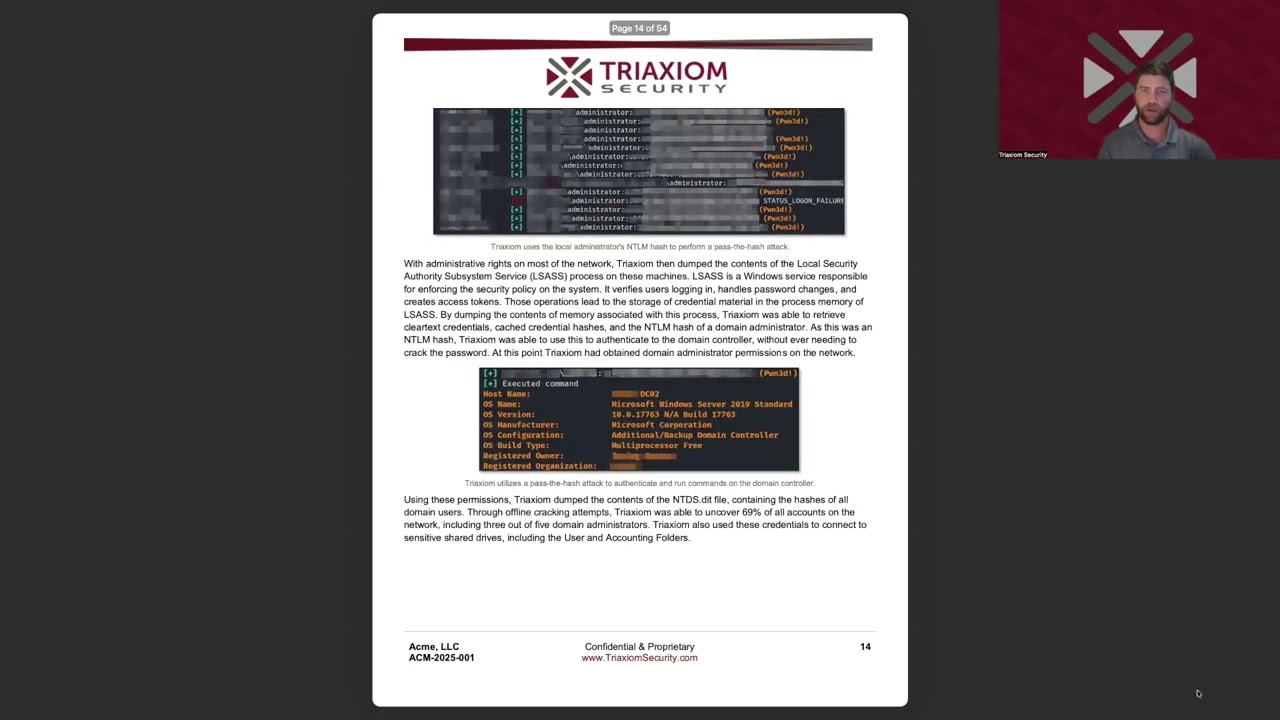
Each client engagement concludes with a comprehensive report that clearly outlines your organization’s security posture and testing results. Key features of the report include:

  • Executive summary highlighting strengths, risks, and takeaways
  • Detailed results from the web application penetration test
  • Clear descriptions of risks, affected systems, evidence, and prioritized remediation recommendations
  • Visual summaries and a risk rating scale
  • Roadmap to gradually improve security posture

Web Application Pen Test FAQs

At the end of the day, penetration testing companies should base the cost of an assessment on the time it takes an engineer to do the required work. Using some basic questions, we can estimate the time required to perform a thorough assessment. For example, if you have a small web application with only one user role, an assessment would cost ~$12,000. But on the other hand, if your web application has multiple roles to test and a significant number of unique pages/forms, that takes longer for an engineer to adequately evaluate, and might cost closer to $23,000.

Much like cost, the time required to perform an web application penetration test can vary by the size of the application. With that said, most web application penetration tests take around one to two weeks.

At Triaxiom Security, we do everything we can to give you a holistic view of your risk by emulating the real-world attacks you are likely to face. However, we also understand the impact that outages can cause and do everything we can to avoid any disruptions. We do not exploit any denial-of-service vulnerabilities and do not perform any stress/load testing.

With that said, there is always a small chance of accounts getting locked out or an unstable sytem experiencing an outage. When that happens, we stop all testing, figure out what caused the issue, and work with you to identify any root causes of instability and adapt our testing going forward to meet your needs.

Our engineers have industry leading certifications including:

  • PCI Qualified Security Assessor (QSA)
  • Certified Information Systems Security Professional (CISSP)
  • Certified Ethical Hacker (C|EH)
  • Offensive Security Certified Professional (OSCP)
  • Offensive Security Web Expert (OSWE)
  • GIAC Security Essentials Certified (GSEC)
  • GIAC Certified Incident Handler (GCIH)
  • GIAC Web Application Penetration Tester (GWAPT)

Get A Web App Pen Test Quote

 Find and fix vulnerabilities that ACTUALLY impact your business and compliance goals faster.